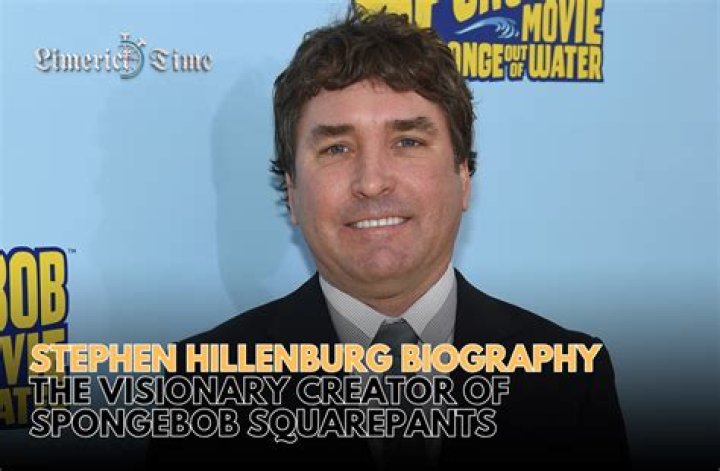
Stephen Hillenburg’s net worth is ![]() $90 Million
$90 Million
Stephen Hillenburg Wiki Biography
Stephen McDannell Hillenburg, a renowned marine biologist, film director, and producer, was born on 21 August 1961 in Lawton, Oklahoma, USA. He is best known for creating the Nickelodeon animated series “SpongeBob Square Pants”.
Stephen Hillenburg’s net worth is estimated at $90 million. This sum has steadily increased through his incomes from directorial film projects, voice acting, and his work as a marine biologist.
Stephen Hillenburg Net Worth $90 Million
Stephen Hillenburg’s childhood was spent in Anaheim, California. His father, Kelly, worked for aerospace companies, including the Apollo project, and his mother, Nancy, was a teacher of the visually impaired. In 1984, he graduated from Humboldt State University with a degree in marine resource planning and interpretation. Subsequently, he became a teacher of marine biology at the Ocean Institute in California. Hillenburg also graduated in animation from California Institute of the Arts, marking the start of his net worth’s ascent due to his work in the film industry. He began as a co-writer and co-producer of the television series “Rocko`s Modern Life”, working with its creator, Joel Murray.
His success with “Rocko`s Modern Life” led him to create the animated television series “SpongeBob SquarePants”, which debuted in 1999 and is still in rotation on the Nickelodeon Channel. This children’s comedy series has earned him six Annie Awards and one Emmy Award.
Stephen established United Plankton Pictures, a production company that produced “SpongeBob SquarePants”. He also voiced the character Potty the Parrot. As a writer, executive producer, showrunner, and storyboard director of “SpongeBob SquarePants”, the series’ cultural and financial success inspired him to create a film adaptation, “The SpongeBob SquarePants Movie”. The movie significantly augmented his net worth and earned him an Annie Award for Directing in a Feature Position. “SpongeBob SquarePants” and its movie have been the primary sources of revenue for Hillenburg’s net worth. He has also contributed to the production and distribution of other films, such as “The Green Beret” (1991), “Mother Goose and Grimm” (1991), and “Wormholes” (1992).
Stephen Hillenburg’s personal life includes marriage to Karen Hillenburg, a chef and cooking school teacher, since 1994. They have a son, Clay, born in 1998. They reside in San Marino, Southern California. Hillenburg’s hobbies include scuba diving, snorkeling, surfing, and painting surreal seascapes.
- Structural Info
- Quotes
- Facts
- Pictures
- Filmography
- Awards
| Full Name | Stephen Hillenburg |
| Net Worth | $90 Million |
| Salary | $90 million dollars |
| Date Of Birth | August 21, 1961 |
| Place Of Birth | Lawton, Oklahoma, United States |
| Profession | Animator, Television producer, Television Director, Screenwriter, Voice Actor, Marine biologist, Film director, Film Score Composer, Storyboard Artist, Soundtrack Composer |
| Education | Humboldt State University |
| Nationality | United States of America |
| Spouse | Karen Hillenburg |
| Children | Clay Hillenburg |
| Parents | Kelly N. Hillenburg, Jr, Nancy Hillenburg |
| Nicknames | Stephen McDannell Hillenburg , Stephen Hillenberg , Stephen Hilleburg , Steve Hillenburg , Steven Hillenburg , Hillenburg, Stephen , Stephen McDannell “Steve” Hillenburg |
| IMDB | |
| Awards | Annie Award for Directing in a Feature Position, Emmy Award |
| Music Groups | Loser |
| Nominations | Annie Awards, Emmy Award |
| Movies | “The SpongeBob Movie: Sponge Out of Water”, “The Green Beret” (1991) |
| TV Shows | “Rocko`s Modern Life”, “SpongeBob SquarePants” |
| # | Quote |
|---|---|
| 1 | Working as a marine science educator, I had the chance to see how enamored kids are with undersea life, especially tide pool creatures. By combining this knowledge with my love for animation, I came up with SpongeBob SquarePants. |
| 2 | Even the villainous Plankton, he’s still flawed and you still root for him in a way, and the style of humor is simple and it’s about human behavior, and everybody can identify with that. |
| 3 | At first I drew a few natural sponges — amorphous shapes, blobs — which was the correct thing to do biologically as a marine science teacher. Then I drew a square sponge and it looked so funny. I think as far as cartoon language goes he was easier to recognize. He seemed to fit the character type I was looking for. [Washington Post, Oct. 15, 2001] |
| 4 | When you set out to do a show about a sponge, you don’t expect the kind of appeal that he’s had. [Detroit News, August 8, 2002] |
| 5 | I think the connection to SpongeBob is that sponges are the most elastic, changing, plastic creatures . . . and I wanted him to be able to do things that were really magical. So [SpongeBob] has these really creative moments when he can re-form himself. But most sponges in the ocean are sedentary: They attach themselves to a rock and sit and filter-feed the rest of their lives, and reproduce, and that’s about it. Not that they are not interesting, but they are not . . . mobile. They don’t cook Krabbie Patties! [Washington Post, Oct. 15, 2001] |
| 6 | [when asked why the octopus has six tentacles instead of eight:] “Technically I just thought he’d be a little too cumbersome as a character to have too many legs visible. Maybe that’s why he’s so angry!” |
| 7 | Our characters act silly, even totally ridiculous at times, and most of our jokes don’t come out of pop cultural references. It seems like we’re aiming at a child audience, everyone can laugh at the basic human traits that are funny. It’s playful, the humor is playful, the world is playful. |
| 8 | We want the show to be really funny. But I think in the end the message is: Treat people the way you expect to be treated. And another connection to any sort of message is that a lot of the stories come out of the personal experience I and the other writers had as kids–the harsh lessons in life which are usually very funny in retrospect, like maybe what happens when you learn your first curse word and you don’t know what it means. [Washington Post, Oct. 15, 2001] |
| # | Fact |
|---|---|
| 1 | As a child he loved the films of Jacques Cousteau, so Stephen Hillenburg earned a degree in natural-resource planning and interpretation, with an emphasis in marine resources from Humboldt State University (Arcata, Calif.) in 1984. For three years he taught marine biology at the Orange County Marine Institute (now known as the Orange County Ocean Institute), in Dana Point, California. He had always enjoyed drawing and painting, so he pursued a master’s-degree program in experimental animation at the California Institute of the Arts, in Valencia. All these experiences came together to create SpongeBob SquarePants. |
