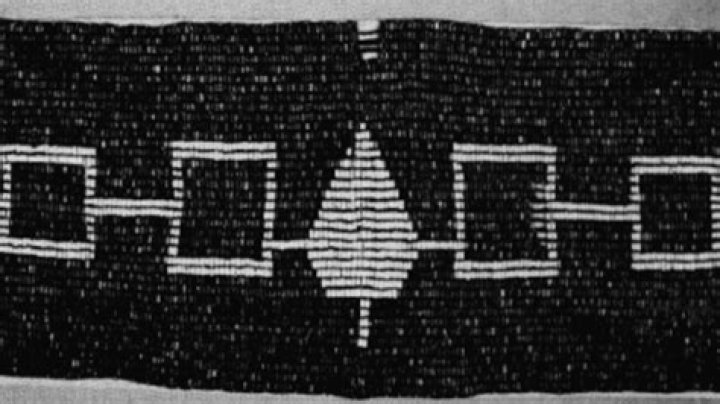
The Hiawatha Belt commemorates and symbolizes five warring nations that made peace and formed the Haudenosaunee: the Seneca, Cayuga, Onondaga, Oneida, and Mohawk. This is the left-to-right order of the symbols, with the Onondaga represented by the tree in the middle (via Onandaga Nation). It was in this nation that all parties buried weapons beneath a Tree of Peace. The Seneca were the westernmost tribe, with the Mohawk forming the eastern border, represented by their positions on the wampum. Later, around 1722, the Tuscarora became the sixth nation of the confederacy, according to History. The belt was not modified to include them.
The wampum also represents the Great Law of Peace, the philosophy of the new Haudenosaunee. It’s a decree that people must “use their minds instead of violence to settle their problems,” explained John Mohawk of the State University of New York at Buffalo (via PBS). “So it is really aimed at passions. It’s aimed at hatreds, and it constructed a very elaborate culture based on negotiations and on the principle of coming together to solve problems using your mind and not your weapons.” The belt’s meaning, then, included tribal unity, a great historical event, and moral law.
While the original belt fell into the possession of New York State in 1900, it was returned to the Haudenosaunee, after much Native American activism, in 1989 (via Indian Country Today).
